

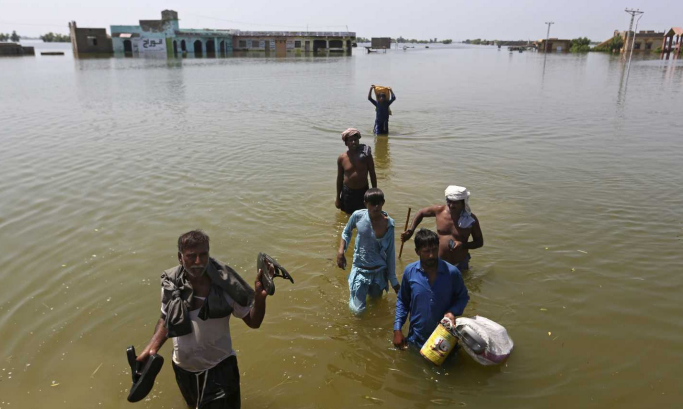
From June to August 2025, Pakistan once again found itself grappling with devastating floods that swept across multiple provinces, displacing millions and leaving behind a trail of destruction. While monsoon rains are a regular feature of the subcontinent’s climate, the intensity, frequency, and unpredictability of recent flooding events point unmistakably toward the growing impact of climate change.
A summer of disasters
Torrential rains across the north and south triggered flash floods, and glacial lake bursts swept away villages in Khyber Pakhtunkhwa and Gilgit Baltistan, river overflows in Punjab, and urban flooding in Sindh. Swat, Shangla, and Buner districts in Khyber Pakhtunkhwa were particularly hard hit, with homes washed away and communication networks disrupted. In Punjab, the Indus and Chenab rivers swelled beyond danger levels, forcing thousands to evacuate to relief camps. Karachi and Hyderabad once again saw major urban flooding due to inadequate drainage systems, paralysing city life. Balochistan, already reeling from drought-like conditions earlier in the year, faced sudden cloudbursts that inundated large swathes of land, destroying crops and livestock.
Pakistan contributes less than one per cent to global greenhouse gas emissions, yet it is among the top five countries most affected by climate change.
By late August, official tallies exceeded 800 deaths and over 1,100 injured nationwide. Tens of thousands of homes – on the order of 7,000 or more – were destroyed or badly damaged. Croplands, roads, bridges and basic services (electricity, water, sanitation) were washed out across all provinces. The United Nations reported that by 21 August, nearly 1,000 people were injured in just a few days of heavy rain. Children and women were among the worst-hit; emergency shelters are full, and disease risk is rising.
The National Disaster Management Authority (NDMA) reported that millions have been displaced, agricultural fields submerged, and key infrastructure — roads, bridges, schools — rendered unusable. The economic toll is expected to run into billions of rupees, compounding the country’s financial strain.
Emergency response
The federal government declared a national emergency, coordinating with provincial disaster management authorities to mobilise rescue operations. The Pakistan Army, Navy, and Air Force were deployed to evacuate stranded communities and deliver food and medical supplies. Prime Minister Shehbaz Sharif visited affected districts in Gilgit-Baltistan, Khyber Pakhtunkhwa and Punjab, pledging that “every available national resource will be mobilised” for relief and rehabilitation.
Pakistan’s recurring floods underscore the urgent need for climate reparations. Wealthier nations of the Global North, historically responsible for the bulk of carbon emissions, must bear a greater responsibility in financing adaptation and recovery for vulnerable countries.
Provincial governments launched their own initiatives. Sindh established emergency shelters in Karachi and interior districts, while Punjab focused on strengthening embankments along major rivers. Non-governmental organisations, including the Edhi Foundation, Alkhidmat Foundation, and international agencies such as the Red Cross, played a crucial role in filling gaps. Their volunteers provided food rations, clean water, and medical camps, often reaching communities long before official aid arrived. Social media campaigns also helped mobilise donations and amplify the voices of flood victims.
Pakistan’s vulnerability to climate change
Pakistan contributes less than one per cent to global greenhouse gas emissions, yet it is among the top five countries most affected by climate change. The current floods are not isolated events but part of a pattern: rising global temperatures are causing erratic monsoon cycles, accelerated glacial melt in the north, and more frequent extreme weather events. The devastating floods of 2010 and 2022 were harbingers of what has now become a recurring crisis.
Mitigation and adaptation: current policies
Pakistan has indeed recognised climate risk in policy and launched some initiatives before this crisis. In 2012, it adopted a National Climate Change Policy, updated by a National Adaptation Plan in 2023, which outlines measures for water, agriculture, and disaster resilience. In its 2021 Paris pledge (NDC), Pakistan committed to shift 60 per cent of its electricity to renewable sources by 2030 and reduce emissions 15–35 per cent below business-as-usual levels.
Concrete programmes have included tree-planting drives. These reforestation efforts improve watershed health and are explicitly aimed at combating climate-induced flooding and erosion. Pakistan has also built the Quaid-e-Azam Solar Park in Bahawalpur and several wind farms to reduce coal dependence. Internationally, it participates in climate finance: new projects (with Green Climate Fund and UN agencies) are backing early warning systems and community resilience in Sindh and KP.
Nevertheless, experts say implementation remains uneven. As of fiscal year 2024, renewables (excluding hydro) contributed only around 5 per cent of energy generation. Installed renewable capacity stood at about 12 per cent. However, a dramatic uptick in solar adoption has flipped the energy mix. According to some sources, solar alone supplied over 25 per cent of Pakistan’s electricity in early 2025, making it the leading source during that period. Policies to retrofit cities or enforce land-use planning are only now being updated in light of the flood disaster. In short, Pakistan has frameworks in place, but now urgently needs to turn them into action.
Recommendations for the Future
To mitigate the impacts of climate change and reduce future flood risks, Pakistan needs to prioritise:
- Strengthening early warning systems through investment in meteorological technology and local communication networks.
- Improving urban planning, including drainage systems in major cities and enforcement of zoning laws to prevent construction in flood-prone areas.
- Climate-resilient agriculture by promoting crop varieties that can withstand floods and droughts, along with better water management practices.
- Strengthening embankments and flood defences along the Indus and its tributaries.
- Community-based adaptation strategies, empowering local populations with training and resources to respond quickly to disasters.
The case for climate reparations
Perhaps, most importantly, Pakistan’s recurring floods underscore the urgent need for climate reparations. Wealthier nations of the Global North, historically responsible for the bulk of carbon emissions, must bear a greater responsibility in financing adaptation and recovery for vulnerable countries. The establishment of the Loss and Damage Fund at COP27 was a step in the right direction, but disbursement remains slow and insufficient.
The floods of June–August 2025 are a grim reminder that climate change is no longer a distant threat but a present reality. Pakistan stands on the frontline of this global crisis, battling forces beyond its control.
For Pakistan, reparations are not a matter of charity but of climate justice. The floods of 2025 have once again shown that the cost of inaction will be borne disproportionately by those least responsible for the crisis. International support in the form of grants, technology transfer, and capacity-building is essential to ensure that Pakistan and other climate-vulnerable nations, can adapt and survive in an increasingly volatile world.
The floods of June–August 2025 are a grim reminder that climate change is no longer a distant threat but a present reality. Pakistan stands on the frontline of this global crisis, battling forces beyond its control. While national efforts are necessary to improve resilience, the international community must also step up and accept responsibility. Without urgent action, both local and global, the cycle of destruction will continue, exacting ever-higher human and economic costs.

Horizon Magazine – PML-N’s Research and Policy Planning Unit & The official publication of PML-N