
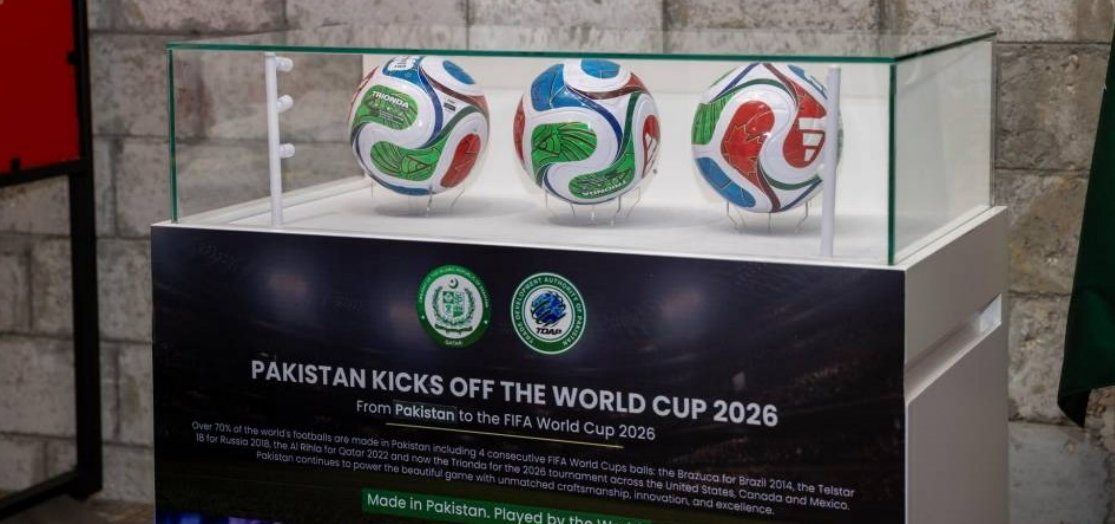
North American countries — the US, Canada and Mexico — are currently hosting the world’s biggest sporting event. As the FIFA World Cup 2026 unfolds, 1,248 players representing 48 teams are battling it out in 104 matches across 16 venues over five weeks. This is over 10,000 minutes of exciting, most competitive football. An estimated seven million spectators will watch matches in stadiums, and more than six billion are estimated to watch live on televisions or digital platforms. The official match ball used in every match is the Adidas Trionda, manufactured in Pakistan.
Since the 1982 FIFA World Cup in Spain, when Pakistan-made Adidas Tango footballs took centre stage, Pakistan’s sustained rise as the world’s leading football manufacturer has been nothing short of phenomenal. The Pakistani city of Sialkot has contributed to the manufacturing of official FIFA World Cup match balls for several tournaments since 1982.
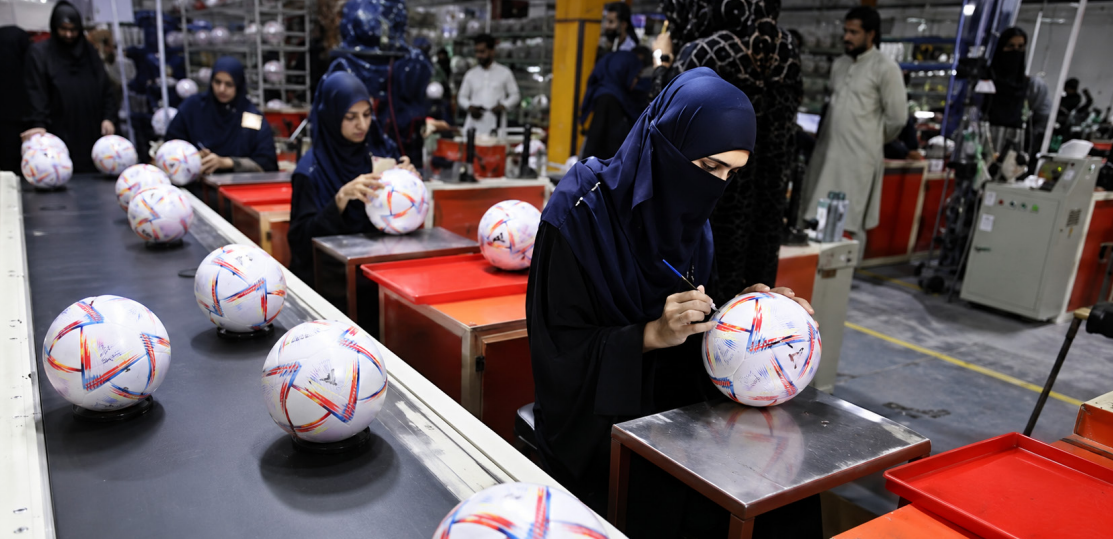
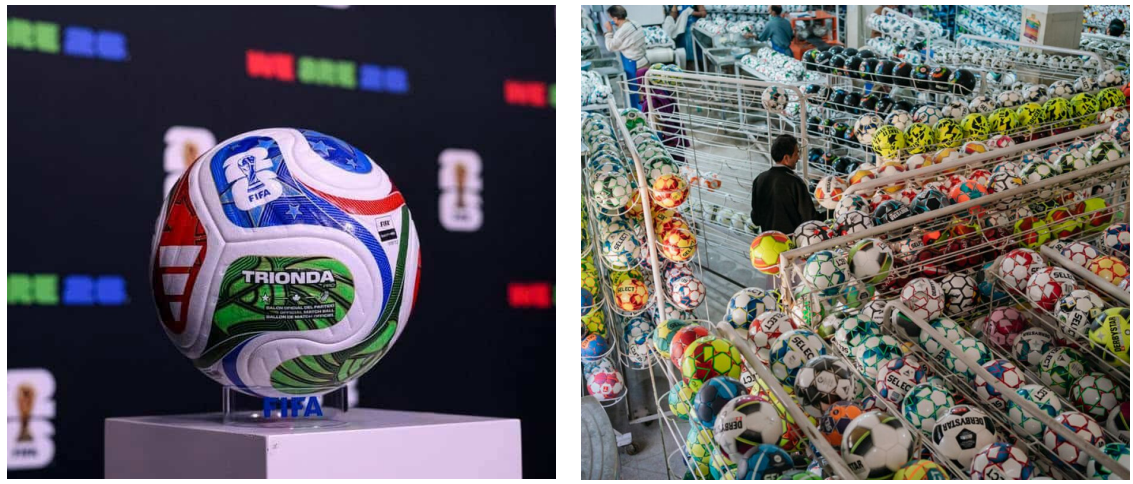
Sialkot is rightly called “The Football Factory” because it produces around 60-70 per cent of the world’s footballs, with a peak capacity of around 300,000 footballs per day. It annually manufactures and exports more than 40 million footballs for more than 50 international brands, exceeding 50 million in World Cup years. It brings more than $190 million in foreign exchange to the country every year. Beyond the FIFA World Cup, leading companies partner with Sialkot to manufacture footballs for numerous international leagues and championships, supplying global markets through a highly efficient global supply chain. These include the UEFA Champions League, the UEFA Europa League, and several leading European domestic leagues, such as Germany’s Bundesliga and France’s Ligue 1.
The 2026 FIFA World Cup’s Adidas Trionda has been produced at Sialkot’s Forward Sports under the leadership of Khawaja Masood Akhtar. Founded in 1991, Forward Sports has emerged as Pakistan’s leading football exporter. The company manufactured the Adidas Brazuca for Brazil 2014, the Adidas Telstar 18 for Russia 2018 and the Adidas Trionda for the ongoing 2026 FIFA World Cup. For Qatar 2022, Forward Sports produced millions of Adidas Al Rihla footballs for commercial sale, training and tournament use. However, the sensor-equipped official match balls used during FIFA World Cup matches were manufactured in China to accommodate the integrated Connected Ball technology introduced for the tournament.
The Adidas Trionda combines cutting-edge technology with innovative design. It features a revolutionary four-panel construction with deep seams and a textured aerodynamic surface that enhances grip, ball control and flight stability, while delivering more predictable swerve in varying weather conditions. Its distinctive tricolour design symbolises the three host nations of the 2026 FIFA World Cup.
At the heart of the Trionda is a rechargeable 14-gram inertial measurement unit (IMU) sensor that transmits positional and motion data 500 times per second. The technology tracks the ball’s speed, trajectory and every touch with exceptional precision, providing real-time data to the Video Assistant Referee (VAR) system. This enables faster and more accurate offside and handball decisions, making the Trionda one of the most technologically advanced footballs ever used at a FIFA World Cup.
Pakistan’s remarkable World Cup story began with a visionary academic and entrepreneur, Professor Amin Javed, founder of Sublime Sports. In the early 1970s, he recognised the immense potential of Sialkot’s master craftsmen and envisioned the city as a global hub for football manufacturing.
The turning point came in 1974 when Professor Javed met Horst Dassler, the son of Adidas founder Adolf “Adi” Dassler. At the time, Adidas was facing severe manufacturing constraints in its European production facilities. Seizing the opportunity, Professor Javed showcased the exceptional hand-stitching skills of Sialkot’s craftsmen. The meeting led to a historic partnership, with Sublime Sports becoming the first Sialkot-based company to sign an official football manufacturing agreement with Adidas.
That partnership transformed not only a company but an entire industry. In 1982, the Adidas Tango España, handcrafted by Sublime Sports, became the official match ball of the FIFA World Cup in Spain. It was the world’s first water-resistant football, featuring a rubber inlay beneath its hand-stitched seams to prevent moisture absorption during wet conditions. The ball’s outstanding performance brought international recognition to Pakistan and was immortalised in the acclaimed short documentary A Ball Named Tango (1981), which introduced Sialkot’s craftsmanship to a global audience.
The success of the Tango laid the foundation for a lasting partnership between global sports brands and Sialkot’s football manufacturers. Sublime Sports went on to produce the official match balls for five consecutive FIFA World Cups: the Adidas Tango (Spain 1982), Adidas Azteca (Mexico 1986), Adidas Etrusco Unico (Italy 1990), Adidas Questra (USA 1994) and Adidas Tricolore (France 1998).
What began with a single partnership in the 1970s transformed Sialkot into one of the world’s foremost centres of football manufacturing.
The achievements of Sublime Sports established Sialkot as the world’s premier centre for hand-stitched football manufacturing. Although football manufacturing has expanded to several countries, Sialkot has retained its reputation as the world’s premier centre for high-quality football production by continually adapting to new technologies while preserving the craftsmanship that first earned it international acclaim. From thermal bonding and precision moulding to advanced materials and smart-ball technology, its manufacturers have consistently adapted to every new phase of the game.
What began with a single partnership between Professor Amin Javed and Adidas evolved into an industrial transformation for Sialkot. During the 1980s, dozens of international sporting goods brands established manufacturing partnerships in the city, transforming it into the undisputed capital of the world’s hand-stitched football industry. Today, Sialkot’s legacy continues to shape football’s biggest stage.
The enduring strength of Pakistan’s football industry lies not only in its craftsmanship but also in its commitment to ethical manufacturing. Leading manufacturers adhere to internationally recognised standards on safe working conditions, the elimination of child labour, fair wages and environmentally sustainable production. Compliance is regularly audited and certified by international organisations, including FIFA, the International Labour Organisation (ILO) and independent monitoring bodies.
Over the past five decades, Pakistan’s football industry has continually reinvented itself. From the pioneering vision of Professor Amin Javed in the 1970s to the technological leadership of Khawaja Masood Akhtar in the last decade, it has successfully adapted to changing market demands, global supply chains and evolving manufacturing technologies. The journey from 32-panel hand-stitched footballs to today’s four-panel, thermally bonded, sensor-equipped match balls reflects an industry that has embraced innovation without losing the craftsmanship that built its global reputation.
Although modern footballs increasingly rely on advanced materials, automation, and embedded technology, the skill and precision of Sialkot’s workforce remain at the heart of their production. Meeting FIFA’s exacting standards for roundness, seam integrity, durability, flight characteristics and all-weather performance continues to demand exceptional manufacturing expertise.
Pakistan’s football industry has continually reinvented itself—adapting to every technological leap while preserving the skills that earned it global recognition
As Pakistan pursues export-led economic growth, the sports goods industry remains one of its most promising sectors. With supportive government policies, investment in technology, skills development and export facilitation, Pakistan can further expand its presence in international markets. The story that began in Sialkot more than half a century ago is still being written, one football at a time, carrying Pakistan’s craftsmanship, innovation and industrial excellence to pitches across the world.

The writer has a diverse career as a medical doctor, writer, and businessman across multiple countries, with a special interest in research and narrative building.