
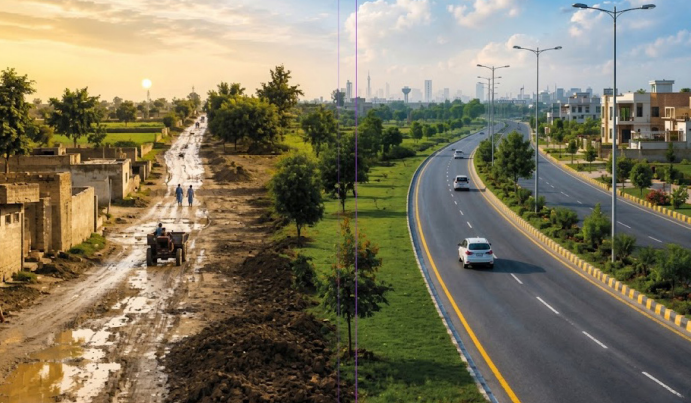
Punjab’s katcha areas have long been politically neglected. Deprived of opportunities and basic state services, many residents drifted away from the mainstream and, in some cases, developed distrust toward the state. In this context, Chief Minister Maryam Nawaz Sharif has attempted to address these long-standing challenges through a development package for the people of southern Punjab’s katcha belt.
Comprising low-lying riverine floodplains along the Indus River, where the land is soft, fertile, and shaped by seasonal flooding, the katcha belt mainly stretches across districts such as Rajanpur, Dera Ghazi Khan, Muzaffargarh, Layyah, Bhakkar, and extends up to Mianwali. These areas have long posed a security threat due to dense riverine terrain, limited state access, and natural cover that can be exploited by criminal groups.
However, when the state acts as a welfare guardian, major transformations become possible. In this spirit, the Punjab government has announced a Rs23 billion package for the long-neglected katcha belt, often associated with insecurity and underdevelopment.
Under the leadership of Maryam Nawaz Sharif, the initiative combines security consolidation with development through roads, schools, healthcare, and governance reforms. Following operations against criminal networks, the government claims that state authority has now been firmly restored in several vulnerable areas.
As the chief minister has stated, the aim is to bring the katcha belt into Punjab’s development mainstream, where citizens experience the state as a source of protection and opportunity rather than fear. In this vision, development is presented not as separate from security, but as its long-term continuation through stronger institutions and public inclusion.
A shift in governance philosophy
The Punjab government’s approach marks a structural transition from episodic policing to long-term stabilisation. Historically, the katcha belt has remained a governance paradox — fertile yet underutilised, strategically important yet administratively fragile, and socially resilient yet economically deprived.
The current package attempts to break this cycle by integrating enforcement gains into developmental frameworks. Instead of treating security and development as separate policy silos, the state is combining them into a single continuum: enforcement creates space, and development sustains it.
However, comparative governance experience in Pakistan suggests caution. Similar transitions in parts of Sindh’s riverine belt and formerly volatile districts of Khyber Pakhtunkhwa have shown that without sustained institutional presence, early gains can regress. The real challenge lies not in clearing territory but in sustaining governance.
Balancing security and social investment
The Rs23 billion package is divided into three major components:
• Rs7.1 billion for law and order
• Rs13.9 billion for social infrastructure
• Rs1.7 billion for other development sectors
This allocation reflects a hybrid governance model where security is positioned as the foundation of development. Unlike conventional planning where social sectors dominate, the significant allocation to law and order underscores the security-development nexus of the katcha belt.
Punjab Information Minister Azma Bokhari stated, “Our aim is not only to clear criminal elements but to ensure that development becomes irreversible, so that no space remains for the return of parallel systems.”
Land redistribution
A defining feature of the package is the distribution of 14,500 acres of state land under the “Apna Khet, Apna Rozgar” scheme. This initiative seeks to convert landless residents into productive agricultural stakeholders, addressing one of the structural drivers of rural vulnerability.
In riverine economies, land is a mechanism of survival, influence, and stability. By formalising ownership, the state is attempting to dismantle informal power structures that often sustain criminal economies in fragile zones.

Infrastructure as governance expansion
Infrastructure development lies at the heart of this strategy. Road construction in the katcha belt symbolises not only improved connectivity but also the restoration of state authority in neglected areas. Similarly, the upgradation and establishment of schools and girls’ colleges reflect a long-term commitment to education and social integration. Merit-based scholarships and free laptops add a digital dimension to these reforms, though their success will depend on sustained infrastructure and teacher capacity.
Security modernisation and digital governance
Security remains the backbone of the initiative. The introduction of solar-powered drone surveillance, advanced monitoring systems, and the expansion of the Punjab Safe Cities Authority represent a shift toward technology-enabled governance.
This reflects a broader trend in modern policing: surveillance replacing manpower intensity. While this improves oversight, it also introduces challenges related to maintenance, training, and sustainability in remote terrain.
The Rs23 billion package reflects a hybrid governance model where security is positioned as the foundation of development.
The deployment of armoured personnel carriers and surveillance-equipped vehicles further indicates that the state continues to view the region through a dual framework: developmental optimism anchored in security realism.
Social inclusion and economic empowerment
The package also focuses on social and economic uplift. Skills programmes worth Rs125 million aim to improve youth employment, while livestock cards for 1,000 women support household incomes and financial independence.
Similarly, incentives for recruiting local youth into police services aim to strengthen community trust and cooperation. Together, these measures show that lasting stability depends not only on security, but also on economic participation and social inclusion.
Institutional integration
The expansion of services by the National Database and Registration Authority into the katcha belt represents a foundational step in institutional integration. Legal identity is the gateway to education, healthcare, banking, and political participation.
Without documentation, communities remain structurally excluded from the formal state. By extending identity registration, the government is effectively expanding the boundaries of governance itself.
Comparative governance perspective
Compared to similar initiatives in Sindh and Khyber Pakhtunkhwa, Punjab’s model appears more comprehensive, combining enforcement, infrastructure, and social policy within a single framework. However, this simultaneity increases administrative complexity, requiring strong interdepartmental coordination. Pakistan’s historical governance challenge has not been policy design but policy execution.
A test of state endurance
The Rs23 billion katcha package is a test of Punjab’s governance model under Maryam Nawaz Sharif. Given her track record of delivering on promises, there is confidence that she will meet this test as well.
The writer, who holds an M.Phil in English Literature, is an educationist, crime analyst, and youth commentator affiliated with PML-N.