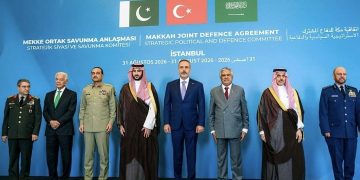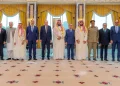

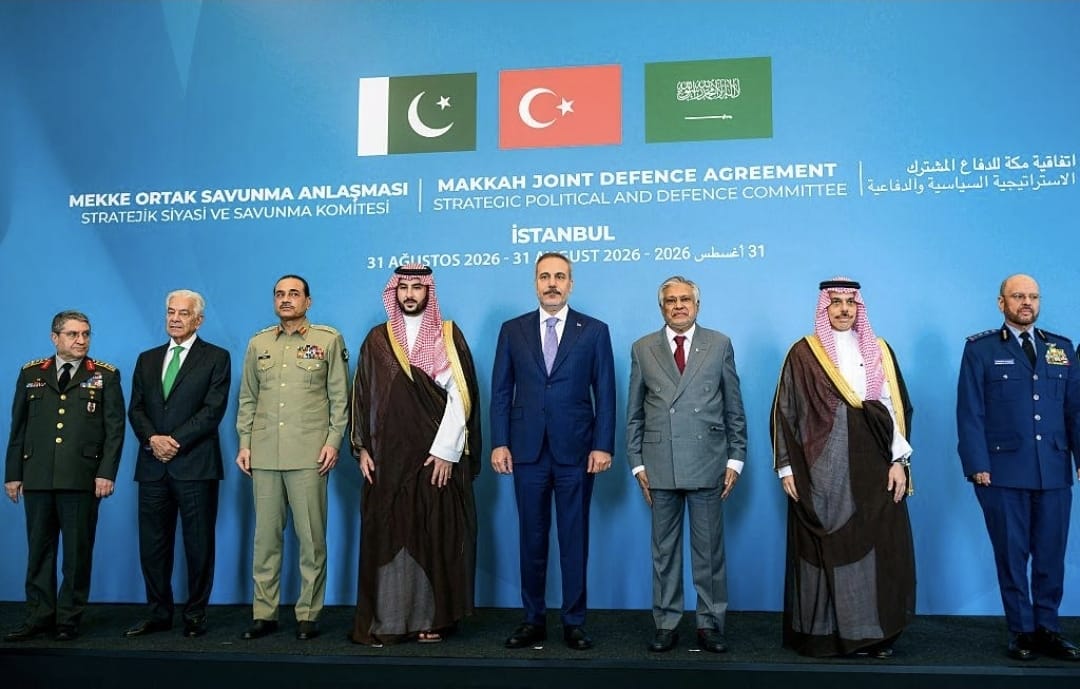
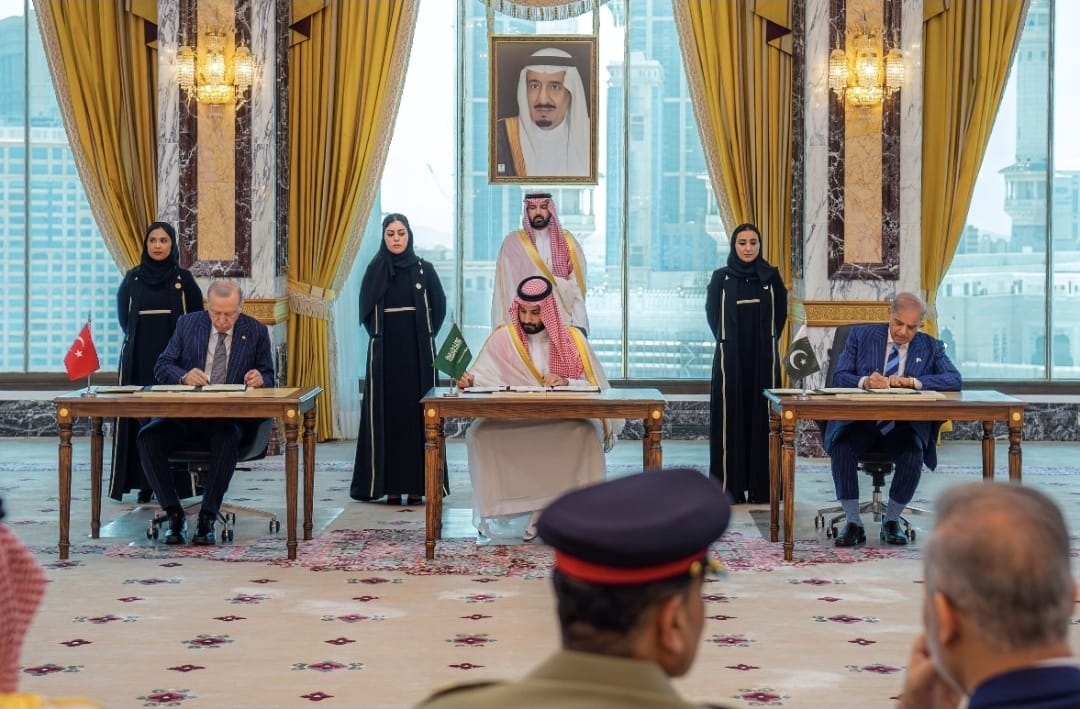
The Makkah Joint Defence Agreement between Pakistan, Saudi Arabia and Türkiye is rapidly moving beyond a political declaration towards an institutionalised framework for security cooperation. Signed in Makkah on 7 August 2026, the agreement has since progressed through ministerial, diplomatic and military consultations, with a permanent General Secretariat being established in Riyadh and Pakistan providing its first secretary general for an initial three-year term.
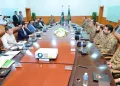
The pace of these developments is significant. The inaugural meeting of the Strategic Political and Defence Committee in Istanbul on 31 August brought together the foreign and defence ministers and military leadership of the three countries. On 25 September, the foreign ministers met in New York on the sidelines of the UN General Assembly, while the military chiefs subsequently met in Riyadh to discuss intelligence sharing, military coordination and closer integration of defence capabilities.
The agreement brings together three countries with complementary strategic strengths, linking Pakistan’s longstanding defence ties with Saudi Arabia to its growing strategic and defence-industrial partnership with Türkiye.
A new dimension to Pakistan’s strategic relationships
Pakistan and Saudi Arabia have maintained close defence ties for decades, including a Strategic Mutual Defence Agreement and long-standing Pakistani military training and advisory support. Islamabad and Ankara, meanwhile, have steadily expanded cooperation in defence production, military training, technology and joint projects.
The Makkah framework brings these relationships into a trilateral arrangement, combining Pakistan’s military expertise, Türkiye’s defence-industrial capabilities and Saudi Arabia’s strategic and economic resources. The Istanbul meeting reinforced this potential by prioritising defence-industry cooperation, joint technology development and production, which could expand opportunities for Pakistan’s defence industry and access to regional markets. Much will depend on translating these commitments into concrete projects and procurement arrangements.
The Saudi security dimension
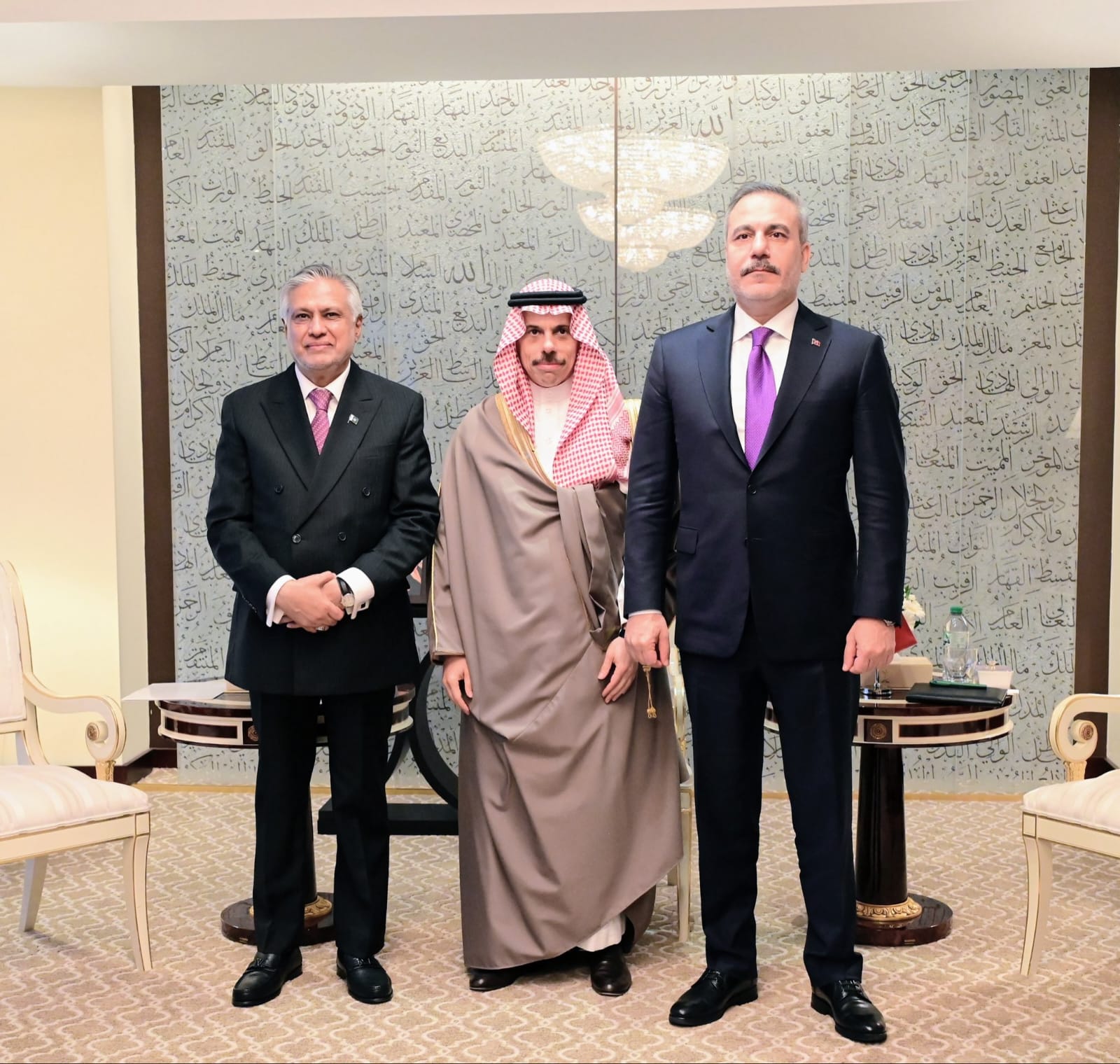
The agreement’s practical significance has sharpened amid heightened regional security concerns. At their 25 September meeting in New York, the three foreign ministers reaffirmed Saudi Arabia’s right to self-defence under Article 51 of the UN Charter, followed by a meeting of their military chiefs in Riyadh on intelligence sharing, military coordination and closer integration of defence capabilities.
For Pakistan, this provides an early test of what collective defence will mean in practice. The distinction between political support, intelligence cooperation, military assistance and direct combat involvement will be important, as the agreement does not imply automatic deployment of Pakistani forces in every crisis. The three countries will need clear mechanisms for consultation, threat assessment and decision-making when their national interests diverge.
Implications for Pakistan’s security
The agreement gives Pakistan an additional layer of strategic relationships at a time when its security environment extends well beyond its immediate borders.
The country’s principal conventional security challenge remains centred on South Asia, but developments in the Gulf, Arabian Sea and wider Middle East can also affect Pakistan’s economic and national security interests. Missile and drone warfare, terrorism, maritime security, cyber threats and attacks on critical infrastructure increasingly cross traditional geographical boundaries.
Closer cooperation with Saudi Arabia and Türkiye could strengthen Pakistan’s access to intelligence, training, technology and military coordination in several of these areas.
The agreement could connect Pakistan’s military expertise, Türkiye’s defence-industrial capabilities and Saudi Arabia’s strategic and economic resources within a common framework.
Türkiye’s experience with unmanned systems, electronic warfare and defence technology is particularly relevant to Pakistan’s ongoing efforts to develop indigenous capabilities. Saudi Arabia, meanwhile, has substantial resources and growing ambitions to develop its own defence-industrial capacity.
A successful trilateral framework could therefore create a broader ecosystem for defence cooperation rather than simply providing another mechanism for military consultation.
The India factor
The Makkah framework will inevitably be viewed through the lens of Pakistan’s strategic relationship with India. Pakistan has described the agreement as defensive and not directed against any particular country, while placing collective defence within the UN Charter framework.
The arrangement could nevertheless influence strategic calculations during a major regional crisis, given the political and diplomatic implications of an attack involving any member. This does not imply automatic intervention by the other members, but makes the scope and application of collective defence particularly important.
For Islamabad, preserving the agreement’s defensive and non-exclusive character will be important, particularly given Saudi Arabia’s substantial economic and diplomatic relationship with India. This would help prevent the framework from being perceived as part of a wider bloc confrontation.
The Iran question
The Makkah framework also has important implications for Pakistan’s relations with Iran. Its geographical proximity, shared border and interest in regional stability make it important that the arrangement does not become part of a wider regional confrontation. Türkiye and Saudi Arabia also maintain complex relationships with Tehran.
For Islamabad, the value of the framework will therefore depend partly on its ability to strengthen collective deterrence while preserving diplomatic space with neighbouring and regional states. Pakistan’s emphasis on sovereignty, non-interference, peaceful dispute resolution and respect for the UN Charter can help maintain that balance.
Beyond defence: the economic opportunity
The agreement could also have an economic dimension. Defence cooperation increasingly extends to technology, research, manufacturing, supply chains and investment. Pakistan has established capabilities in aviation, armoured vehicles and naval systems; Türkiye has developed a substantial indigenous defence industry, while Saudi Arabia is investing heavily in localising defence production.
Trilateral cooperation could support joint ventures, technology development and access to larger markets for Pakistani and Turkish defence products. For Pakistan, an expanded defence industry could generate foreign exchange, skilled employment and wider technological benefits.
The extent of these benefits, however, will depend on concrete industrial agreements, financing arrangements and technology-transfer mechanisms. These will determine whether defence cooperation translates into sustained economic gains.
A framework that could expand
The three countries have indicated that the agreement remains open to additional members that share its principles.
Expansion could increase the framework’s geographical reach and collective capabilities. But it would also introduce more diverse strategic interests and threat perceptions.
For Pakistan, the credibility of the initial three-member arrangement may therefore be more important than rapid enlargement. Developing effective mechanisms for consultation, intelligence sharing, military coordination and joint exercises among the founding members would provide a stronger foundation for any future expansion.
The strategic opportunity for Pakistan
The Makkah Joint Defence Agreement comes at a time when Pakistan is seeking to diversify its strategic partnerships while avoiding dependence on any single external power.
Pakistan’s appointment of Lieutenant General (Retired) Nauman Mahmood as the first Secretary General, for a three-year term, gives Islamabad an early role in shaping the Riyadh-based Secretariat. Its longer-term significance will depend on the authority and resources vested in the Secretariat and its ability to coordinate and implement the agreement.
The challenge will be to ensure that greater security cooperation does not translate into strategic overextension. Pakistan will need to maintain the ability to determine, on a case-by-case basis, the nature and extent of its response to regional crises while safeguarding its own national-security requirements.
The significance of the Makkah agreement will ultimately be determined by the institutions, capabilities and mechanisms that emerge from it.
For Pakistan, the objective should be to develop the agreement into a credible mechanism for collective deterrence, defence cooperation and regional stability while preserving strategic flexibility and diplomatic space.

Lorem ipsum is placeholder text used in design to show how a layout will look before the real content is added.